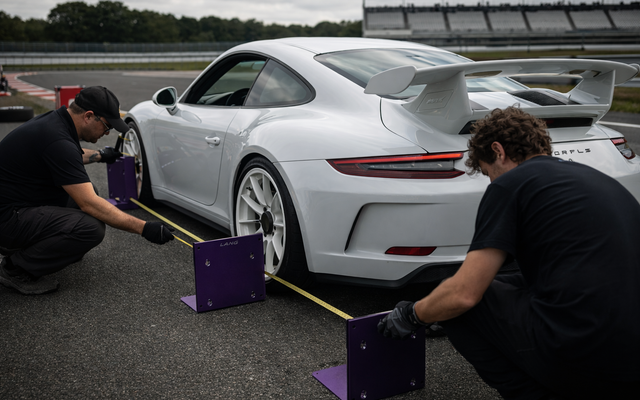
Inside the intensely competitive realm of modern pro-level oversteer competition, success is not merely purely a result of sheer horsepower or behind-the-wheel bravado. Conversely, it is now a intricate discipline that requires a painstaking fusion of picking a time-tested vehicle platform, arming it with the most precise performance hardware, and, most critically, understanding its real-time performance on the circuit through advanced drift telemetry software. This comprehensive manual acts as your master plan from the very first concept of a competition vehicle all the way to the final data-informed refinements that turn a capable vehicle into a repeatable podium finisher. We will delve deep into the art and science of vehicle alignment optimization, demonstrating how a modern suspension tuning tool like precise measurement hardware removes approximation and provides exceptional insight into your car's real-world performance.
The foundation of any exceptional competitive sliding vehicle is, undoubtedly, the base vehicle itself. Certain vehicles have achieved legendary reputation within the international oversteer culture due to their built-in balance, durable build quality, and the vast range of aftermarket components available. Selecting the right car is the initial and most significant decision a enthusiast will make. As an example, the BMW's E36 3 Series is widely regarded as one of the finest all-around drift cars of all time. Its almost ideal balanced front-to-rear weight, coupled with a RWD layout and extremely reliable six-cylinder motors, establishes a chassis that is simultaneously forgiving for novices and highly effective in the possession of a expert competitor. The next step of this concept, the BMW E46, improves on these attributes with a increasingly developed structure, wider track for improved confidence, and yet increased lock directly from the manufacturer. Another dominant option in the top-level scene is the Corvette C6.
This muscle-derived track weapon offers a distinctive array of advantages to the sliding sport, featuring a low-mass aluminum frame, a transaxle-style gearbox and differential unit that aids in an excellent weight distribution, and the colossal thrust of a powerful LS V8 motor. This blend makes it an complete weapon on track, able of initiating and holding extended slides with relatively easy use of power. For builders looking for outstanding bang-for-the-buck, the Nissan 350Z excels as a prime candidate. It arrives from the manufacturer with a rigid chassis, a effective original LSD, and the free-revving V6 powerplant that delivers plenty of horsepower and torque for learning and advancing in the activity. Its successor, the Nissan Z34, presents further refinements in body strength, steering geometry, and peak motor performance, establishing its place as a common selection among professional pilots. Other iconic vehicles that merit mention encompass the agile rotary-powered FC generation RX-7, the most popular S13 Silvia/240SX, the V8-powered Ford Mustang SN95, the more recent BMW E90, and the compact yet surprisingly fun and teachable MX-5 Miata. Each of these cars provides a distinct set of traits, difficulties, and capabilities, but they all share the basic components required to be transformed into a competitive sliding vehicle.
However, choosing the correct platform is just the first step. To release the complete capability of any of these machines, significant upgrades to the steering geometry and suspension systems are utterly essential. This is where the realm of performance drift-spec hardware becomes critical focus. The most most impactful upgrade for a dedicated competition vehicle is the integration of a high-performance drift angle kit. These sophisticated kits, like those manufactured by specialist companies like specialist manufacturers, are created to radically enhance the vehicle's possible lock-to-lock rotation. A OEM production vehicle is severely constrained in how far its steering tires can rotate, a engineering trade-off for daily operation. In drifting, but, maximum countersteering is continuously required to manage and hold a slide. An steering kit replaces the OEM steering knuckles, linkages, and often A-arms with components that allow the wheels to attain angles beyond 70 or even 80 degrees, compared to a average OEM limit of around 40 to 50 degs.
This tremendously increased lock provides the driver with dramatically greater control during a angle, allowing it to be considerably more straightforward to initiate a drift, hold it through a extended turn, and switch seamlessly from one angle to another. The improvement in handling is truly transformative. Paired with a appropriately specified steering kit is the equally vital enhancement to the vehicle's spring and damper setup. Store-bought or even expensive sport dampers are just not designed for the specific and extreme needs of drifting. A drift-spec set of coilovers is crucial. These specialized coilovers feature unique piston tuning and spring strength that are designed for the violent load shifting that is inherent of sliding. When a pilot begins a slide, the car's mass is shifted rapidly to the front of the turn. Correct performance coilovers manage this transfer in a predictable way, enabling the chassis to find its balance quickly and offering the driver accurate feedback through the steering wheel and seat. They furthermore provide precise tuning of stance, rebound and compression firmness, and corner weighting, which are all fundamental aspects of fine-tuning the car's handling to a particular track or piloting style. In combination, a high-quality angle modification system and a properly chosen set of drift-spec suspension units form the undeniable mechanical base upon which all future tuning is constructed.
Once the essential hardware is in place, the following critical stage in the development is the meticulous tuning of the vehicle's suspension geometry. This is the world of vehicle alignment optimization, a methodology that can seem daunting to the newcomer but is, in fact, the defining factor to transforming a assembly of capable pieces into a cohesive and predictable vehicle. The most critical parameter of alignment for drifting is undoubtedly camber angle. Camber angle is the inclination of the rim compared to the vertical axis when looked at from the forward of the chassis. If the top of the wheel is tilted inward, this is called negative camber. For drifting, an inward tilt on the front axle wheels is universally employed and is considered critical. The purpose is deeply tied to vehicle dynamics.
When a car is turning at high slip angles, the body rolls to the outer of the turn. This lean forces the outer front wheel to lose its best footprint with the track surface. By introducing negative camber, the wheel is pre-leaned to counteract this roll. As the chassis tilts into the corner, the outside front tire gains a better contact patch against the track, maximizing its bite at the exact point when it is most required for control. Commonly, front axle camber settings car suspension tuning for a serious drift machine fall between approximately -3 degrees to as much as -5 degrees or even more, based on the specifics of the vehicle configuration, tire choice, and pilot preference. The rear axle wheels also utilize negative camber, but the angles are generally more modest and subtler than the front axle. Excessive negative camber at the rear can make the car extremely loose and hard to control on throttle application, as it diminishes the usable tire footprint of the driven wheels during forward acceleration. Hence, rear axle adjustments are frequently in the range of -1 degree to -3 degrees, striking a careful balance between offering adequate cornering bite to aid in initiating and holding the angle while still preserving good hook-up for power-down the corner. alignment is only one component of the more complex tuning equation, which additionally encompasses toe setting, caster angle, and suspension-induced steering adjustment.
Toe angle describes the orientation of the tires when looked at from the top. Positive toe means the leading edges of the tires are closer together than the trailing edges, while outward toe means the opposite. For sliding, a modest amount of front negative toe is frequently run to improve the turn-in steering feel, making the car feel more agile and willing to begin a drift. Rear axle toe is usually set to neutral or a extremely small amount of positive toe to encourage predictability under throttle. self-centering is the forward or backwards tilt of the suspension pivot when looked at from the side-on of the car. Positive caster angle enhances feedback and high-speed stability, and it also adds to inward lean gain during cornering, which is highly beneficial. Adjusting these settings is a complex interaction where a modification to one value can and often will affect the other settings. The conventional approach for tuning a chassis's alignment for drifting has long been a labor-intensive affair of guesswork and adjustment. A driver or crew would make a modification based on intuition, test the car on track, rely on the operator's individual feel and impressions, and then make an additional adjustment. This process would repeat time after time until the car felt "right" or the available testing period was exhausted. This methodology is drift telemetry software not just exceptionally slow in terms of man-hours and tires, fuel, and parts, but it is furthermore fundamentally flawed.
Human sensation is a famously unreliable metric, colored by many factors such as tiredness, evolving track grip levels, temperature, and just the focus of the operator on that given day. What feels "loose" on vehicle dynamics tool one run might feel "pushing" on the next run, resulting in confusing information and frustrating changes. This traditional challenge in car suspension tuning is precisely where modern technology has made its mark to transform the process.
The advent and adoption of advanced vehicle dynamics tools has ushered in a radically different era for tuning and optimizing high-performance drift cars. This new generation of platforms, exemplified by innovative systems like data acquisition tools, function by directly capturing the real-time physical performance of the car as it is operated on the circuit. In contrast to relying on subjective feel, these tools collect quantifiable information on key parameters such as shock absorber movement, corner velocities, G-force loading, wheel angle, and driver input input. This collected data stream is then interpreted by advanced applications that can visualize and decode the data in a clear format. For the first time, engineers and crews can observe precisely what the vehicle is exhibiting at each point of a lap. This function transforms the whole alignment optimization workflow. Think about the aforementioned goal of dialing in the front axle camber for a specific vehicle. Instead of making a modification from -3 degrees to -3.5 degrees and then driving several laps to try and "sense" a difference, a suspension tuning tool can deliver real-time and irrefutable data. The tool can display visually how the suspension's loading is acting during the critical moments of a angle: initiation, mid-corner, and transition. It can show if the current value is enabling the outside front tire to achieve maximum contact or if the tire is overloaded on its external edge.
The software can after analysis suggest fact-based recommendations for modification. Perhaps the telemetry indicates that the outside front tire is still overworking its edge at -3.5 degrees of negative camber, indicating that an increase to angle, say -4 degrees, might be advantageous. On the other hand, the information might indicate that the tire is failing to coming up to heat or that the inside edge is degrading unevenly, which could suggest that there is overly aggressive negative camber and a small lessening back to -3.2 degrees would be more efficient. This standard of precision and actionable insight was literally unattainable in the era of solely manual setup.
The effect of employing a comprehensive suspension tuning tool goes far beyond only setting alignment. It serves as an invaluable coilover setup tips that is tailored to your specific car. When adjusting the shock absorber values on your coilovers, instead of depending on vague tips or mimicking another driver's setup, you can use the telemetry to see how the vehicle is performing in relation to your changes. The tool can display the damper movement trace over a section of track, showing if the dampers are handling the chassis motion properly or if they are permitting the vehicle to oscillate uncontrollably after a flick. It can help in pinpointing issues like excessive compression or excessive extension, permitting you to introduce data-backed adjustments to spring preload, damping settings, or ride height. This process applies equally to the detailed task of car alignment tuning. Beyond camber angle, the software can provide data into how adjustments to toe settings and caster angle are affecting the car's handling during specific maneuvers of a lap. For example, it can allow you to determine the ideal amount of front toe out for your particular steering rack configuration and piloting approach by analyzing the speed of turn-in response and the stability of the vehicle at full lock. This makes the tool an exceptionally useful performance optimization handbook that is dynamically calibrated by the actual performance of your own chassis on the track. It shifts the entire project from a mysterious craft into a scientific optimization exercise.
Additionally, the application of a platform like GripDial is in no way confined to expert teams with vast funding. For the amateur enthusiast, it serves as an incredible force multiplier. It in essence provides the tuner with the analysis of a professional dynamics engineer without needing the corresponding overhead. It accelerates the development time by delivering unambiguous directions to questions that would traditionally take seasons of experience to understand. A builder can understand how their particular vehicle behaves to various inputs, building a more profound knowledge of vehicle dynamics in the endeavor. It also democratizes advanced chassis dynamics principles, allowing all drivers with the desire to refine their car to accomplish it in a structured and successful way. This is notably important in a discipline like drifting, where setup knowledge has historically been a tightly held asset among top drivers. Today, that knowledge can be in the garage of any motivated builder.
In the final analysis, the journey to building and optimizing the ideal championship-contending drift car is a comprehensive project that smoothly combines time-honored mechanical knowledge with revolutionary data solutions. It begins with the wise choice of a legendary chassis, then enhanced by the application of critical performance components like high-performance drift angle kits and correctly specified performance coilovers. The process then advances into the precision realm of chassis dynamics adjustment, where settings like negative camber, toe, and caster angle are precisely set to complement the vehicle's upgraded capabilities and the driver's individual needs. The final step, and what truly distinguishes the modern approach from the old ways, is the adoption of a advanced vehicle dynamics tool. This platform eradicates the guesswork and trial and error of only seat-of-the-pants setup by providing empirical, live data on how the car is actually behaving. It serves as an unparalleled diagnostic aid, a definitive coilover setup manual, and a all-in-one vehicle dynamics tool. As a complete package, this complete approach leads to that all element of the drift machine—from the selection of the chassis to the most minute adjustment on the damper—is perfected for peak success on the circuit. It signifies the complete evolution of the discipline of oversteer driving, merging physical pilot talent with surgical chassis dynamics to build the most competitive cars possible.